
• Add description, images, menus and links to your mega menu

  • A column with no settings can be used as a spacer

  • Link to your collections, sales and even external links

  • Add up to five columns

  • NatroVital Cortisol Calm

    • 100% Alcohol-Free – Traditional Herbal Support for Stress and Nervous System Health
    • Contains herbs traditionally used to ease emotional tension and help you stay calm under pressure
    • Supports a balanced mood and helps you feel more relaxed and in control
    Size
    ✓ Stay Healthy — save 10% with subscription

    Auto-renews, skip or cancel anytime.

    ✓ Stay Healthy — save 10% with subscription

    Auto-renews, skip or cancel anytime.

    To add to cart, go to the product page and select a purchase option
    • Feeling Stressed, Tense and Unable to Relax?

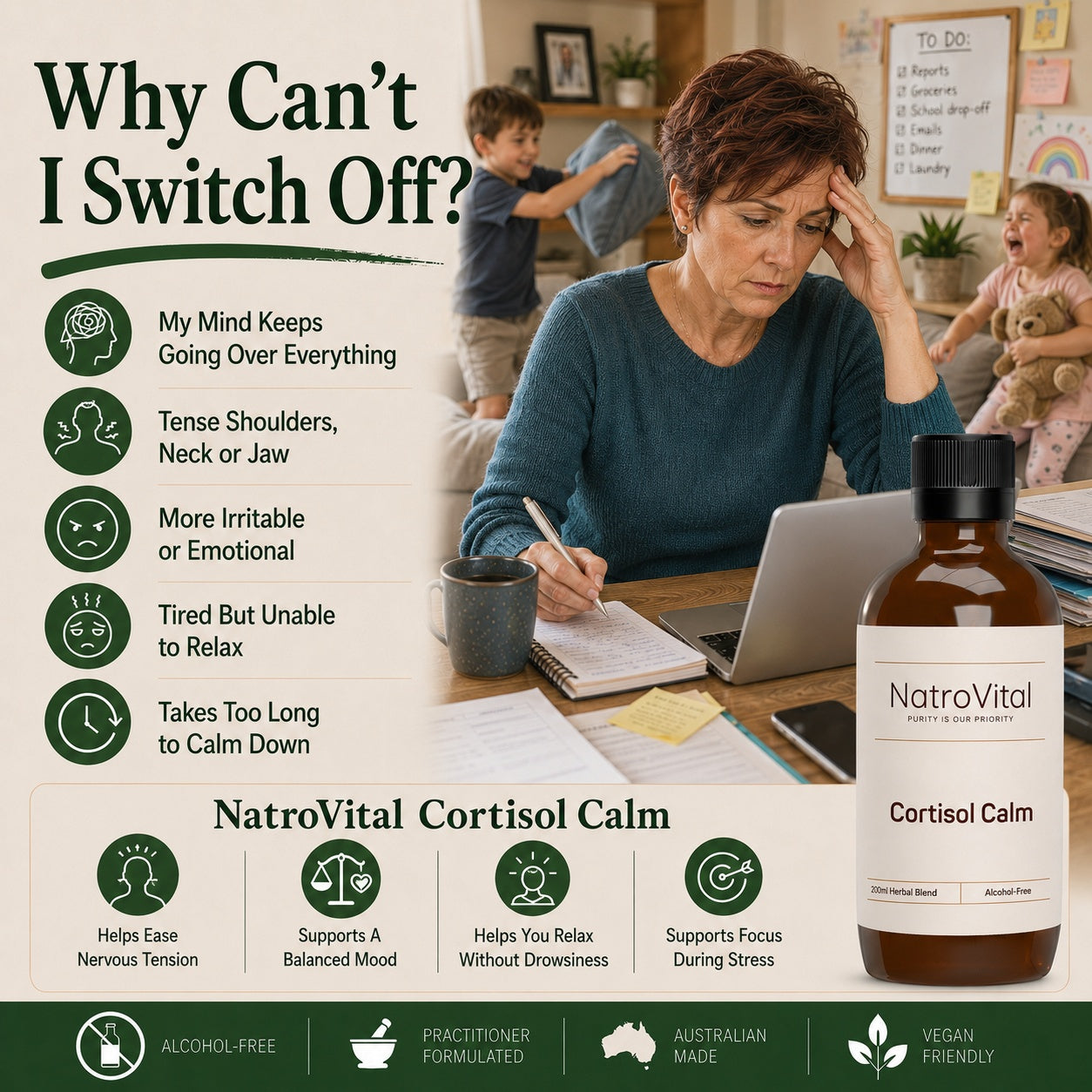
      Stress can affect every person differently. You may find yourself constantly worrying, replaying conversations or lying awake thinking about everything that needs to be done. You may become more irritable, emotional or overwhelmed by problems you would normally handle without too much difficulty.

      For others, stress is felt more in the body. Your shoulders remain tense, your jaw tightens, your heart feels as though it is beating harder, your breathing becomes shallow or you find it difficult to sit down and properly relax.

      You may not think of yourself as anxious. You may simply feel that you are always under pressure—rushing from one responsibility to the next, constantly thinking ahead and never feeling as though you can fully let your guard down.

      There may be very real reasons you feel this way. You could be dealing with pressure at work, financial worries, family responsibilities, health concerns, grief, relationship problems or caring for someone who depends on you. These are not always problems you can simply remove or walk away from. But even when the situation cannot immediately change, your body does not need to remain tense and prepared for the next problem every hour of the day.

      When that pressure continues day after day, your body can find it difficult to switch out of its stress response. Even during quieter moments, the tension can remain.

      NatroVital Cortisol Calm was formulated for these periods—to ease nervous tension and calm a nervous system that has remained on high alert, so you can deal with what is happening without feeling constantly tense, reactive or overwhelmed.

      You Can Be Coping and Still Be Affected by Stress

      Stress does not always look like panic attacks, obvious anxiety or being unable to function.

      You may still go to work, care for your family, meet your responsibilities and appear completely capable to everyone around you. But inside, you may feel more tense, reactive or emotionally stretched than you used to.

      Your patience may be shorter, small problems may feel harder to deal with and it may take much longer to settle after something stressful happens.

      Being able to keep going does not necessarily mean stress is no longer affecting you. It may simply mean you have become accustomed to functioning while your body remains under pressure.

      Coping is not always the same as being unaffected.

      Cortisol Is Not the Enemy

      Cortisol is often described as a harmful stress hormone, but your body needs it. It helps you wake in the morning, remain alert and make energy available when something requires your immediate attention.

      During a stressful situation, this response is useful. It helps you think quickly, react faster and deal with whatever is happening. Once the pressure has passed, cortisol should begin to fall and the nervous system should gradually return to a calmer state.

      The difficulty begins when the pressure does not really stop. Even when one problem has passed, your mind may already be anticipating the next one. The body receives little opportunity to recognise that it is safe to stand down.

      This can leave you feeling switched on when you want to relax, yet mentally and emotionally drained when you need to keep functioning. You may be tired, but still unable to switch off.

      The goal is not to eliminate cortisol. It is to help calm the fight-or-flight response so your body is not continually reacting as though every problem is an emergency.

      Does This Sound Familiar?

      Ongoing stress is not always dramatic. More often, it gradually changes how you feel, react and cope throughout the day.

      • I find it difficult to properly relax, even when I have time to myself.
      • My mind keeps going over problems, conversations or what needs to be done next.
      • I feel tense in my shoulders, neck, jaw or chest.
      • I become irritated or emotional more easily than I used to.
      • Small problems can feel much bigger in the moment.
      • I sometimes feel as though everything is becoming too much.
      • It takes me a long time to settle after something stressful happens.
      • Stress makes it difficult to fall asleep or causes me to wake during the night with my mind suddenly active.
      • I struggle to concentrate when there is too much happening around me.
      • I feel mentally and emotionally drained by the end of the day.
      • I am still doing everything I need to do, but I no longer feel calm while doing it.

      Experiencing several of these signs may mean ongoing stress is beginning to affect how your body is functioning. The stress is no longer only happening around you—it is changing how you feel, react, sleep and recover from each day.

      Why NatroVital Cortisol Calm Was Formulated

      Long before cortisol could be measured in blood or saliva, traditional herbal practitioners recognised the effects of prolonged stress: nervous tension, irritability, difficulty relaxing, restless sleep, low mood, mental fatigue and nervous exhaustion.

      They used calming and restorative herbs to support people who had remained under physical or emotional pressure for too long and were finding it increasingly difficult to switch off.

      NatroVital Cortisol Calm brings this traditional herbal knowledge together in a formula designed to calm nervous tension and reduce the intensity of the stressed, reactive state that ongoing pressure can create.

      Cortisol Calm is not a sedative and was not designed simply to make you sleepy or dull your thoughts. Its purpose is to calm nervous tension without leaving you drowsy, so you can continue to function throughout the day.

      By easing nervous tension, it may also make it easier to unwind at night when stress is making it difficult to switch off and fall asleep.

      NatroVital Cortisol Calm may be suitable for people of all ages when stress is beginning to affect their sleep, mood, patience, concentration or ability to relax.

      Please Note: NatroVital Cortisol Calm has been professionally formulated using traditional herbal knowledge. The information on this page explains the traditional herbal principles behind this formula and is not intended to diagnose, treat, cure or prevent any medical condition. If you would like help deciding whether Cortisol Calm is the most suitable tonic for you, please contact our clinic before purchasing.

      Want to know what’s in this formula?

      Continue to the Ingredients or read the Frequently Asked Questions.

    • Why These Herbs Were Chosen

      NatroVital Cortisol Calm combines herbs from both Western and Ayurvedic herbal traditions. Each was selected for a specific role within the formula, including calming nervous tension, supporting mood, maintaining concentration and helping the nervous system settle after prolonged stress.

      The herbs below are grouped according to the main role they play within the formula. Some appear in more than one section because a single herb may have several traditional uses and contribute to more than one aspect of the formula.

      Herbs Traditionally Used During Periods of Ongoing Stress

      • Organic Ashwagandha (Withania somnifera)
      • Organic Bacopa (Bacopa monnieri)
      • Organic Skullcap (Scutellaria lateriflora)
      • Organic St John’s Wort (Hypericum perforatum)

      These herbs have traditionally been used during periods of prolonged physical or emotional stress, particularly when the nervous system has remained under pressure for too long and is no longer settling as readily between stressful situations.

      Herbs Traditionally Used to Support Mood During Stress

      • Organic Ashwagandha (Withania somnifera)
      • Organic Skullcap (Scutellaria lateriflora)
      • Organic St John’s Wort (Hypericum perforatum)

      These herbs have traditionally been used to support mood during periods of prolonged stress, particularly when irritability, low mood or stronger emotional reactions are also present.

      Herbs Traditionally Used to Support Memory, Focus and Mental Function

      • Organic Ashwagandha (Withania somnifera)
      • Organic Bacopa (Bacopa monnieri)
      • Organic Ginkgo (Ginkgo biloba)

      These herbs have traditionally been used to support memory, attention and the ability to process information. This may be particularly relevant when prolonged stress is contributing to mental fatigue and making it harder to concentrate, organise your thoughts or remain mentally engaged.

      Herbs Traditionally Used When You Are Tired but Cannot Switch Off

      • Organic Ashwagandha (Withania somnifera)
      • Organic Bacopa (Bacopa monnieri)
      • Organic Skullcap (Scutellaria lateriflora)
      • Organic St John’s Wort (Hypericum perforatum)

      Being tired does not always mean your nervous system is ready to rest. You can feel completely exhausted while your thoughts keep moving, your muscles remain tense and your body still feels prepared for the next problem. These herbs have traditionally been used when prolonged stress is making it difficult to mentally and physically settle, helping to calm the stressed, alert state without simply making you drowsy.

      Why We Use Liquid Herbal Extracts

      • Only the concentrated herbal compounds are extracted—not the bulk plant fibre found in powders, tablets and capsules
      • Rapid absorption through the tissues of the mouth and digestive tract
      • Does not rely solely on digestion to begin delivering herbal compounds
      • No synthetic fillers or binders
      • No bulking agents
      • No artificial flavours or sweeteners
      • No unnecessary additives
      • 100% alcohol-free formula

      Unlike powders, capsules and tablets that contain the entire dried herb, our liquid extracts contain only the concentrated plant compounds extracted during our manufacturing process. This allows the herbal constituents to begin interacting with the body from the moment they enter the mouth, without relying entirely on digestion to break down tablets, capsules or plant fibre first.

      Our Commitment to Purity

      • Vegetable Glycerine: Used as a natural preservative and sweetener without the need for artificial additives.
      • Purified Grander Water: Free from chlorine and fluoride, providing a clean base for our herbal extracts.
      • 100% Alcohol-Free: Alcohol is removed after extraction using a low-temperature vacuum process before being replaced with vegetable glycerine and purified water.
      • Vegan & Allergen-Free: Free from gluten, dairy, eggs, soy, nuts, corn, yeast, artificial colours, flavours and preservatives.

      How NatroVital Cortisol Calm Is Made

      We begin with a pharmaceutical-grade alcohol extraction to draw out the broad spectrum of active plant compounds from the raw herbs. Once extraction is complete, the alcohol is gently removed under vacuum at low temperatures to help preserve the integrity of the herbal constituents.

      The concentrated extract is then blended with vegetable glycerine and purified Grander water to create a clean, stable, alcohol-free herbal tonic.

      Every bottle is formulated and produced by us in Australia using small-batch manufacturing methods that prioritise purity, quality and attention to detail.

      Active Herbal Ingredients Per Serve

      Each 1mL of NatroVital Cortisol Calm is made from the equivalent of 500mg of dried herbal material. Rather than containing ground herbs or bulk plant fibre, the alcohol- and water-soluble compounds have already been extracted from the herbs and concentrated into liquid form. This allows each dose to provide the extracted herbal constituents without relying on digestion to first break down dried root, leaf or powdered plant material.

      Want to learn more about the fillers, binders, coatings and additives commonly used in supplements? Read our guide on The Truth About Excipients.

      Still have questions?

      Read our Frequently Asked Questions for dosage information, common combinations and answers to the questions we're most often asked in clinic.

    • NatroVital Cortisol Calm Common Questions

      What is the recommended dosage for NatroVital Cortisol Calm?
      For adults, the typical dosage is 7.5ml twice daily. During periods of elevated stress or nervous tension, 10ml may be taken two to four times daily, or as directed by your healthcare practitioner.
      How should I take Cortisol Calm?
      Measure the recommended dosage and mix with a small amount of water or juice. Drink the entire mixture, including any residue, to ensure full herbal benefit.
      Who is Cortisol Calm most suitable for?

      NatroVital Cortisol Calm may be suitable when ongoing pressure is beginning to affect your patience, mood, concentration, sleep or ability to relax.

      You may still be going to work, caring for your family and meeting your responsibilities, but feel more tense, reactive or emotionally stretched than you used to. You may also find that your mind keeps going over problems, your body remains physically tense or it takes much longer to settle after something stressful happens.

      Cortisol Calm was formulated for people who are still functioning but no longer feel calm while doing everything they need to do.

      Can stress still be affecting me if I am coping?

      Yes. Stress does not always stop you from functioning.

      You may still appear capable to everyone around you while privately feeling tense, irritable, overwhelmed or mentally exhausted. You may have simply become used to pushing through these feelings because the responsibilities in your life have not stopped.

      Being able to keep going shows that you are coping with the pressure. It does not necessarily mean the pressure is no longer affecting you.

      Why am I exhausted but still unable to switch off?

      You have spent the entire day looking forward to finally sitting down or getting into bed. Your body feels heavy, your eyes are tired and you know you need sleep.

      But the moment everything becomes quiet, your mind is still in go mode. You replay a conversation, remember something you forgot to do, think about tomorrow or begin trying to solve a problem that has already occupied you for most of the day.

      This happens because stopping for the day and switching off are not the same thing. You may have finished work, answered the last question and climbed into bed, but your nervous system is still behaving as though there is something else you need to deal with.

      Your body is exhausted, but your mind and nervous system have not yet received the message that it is safe to stand down.

      Why does my mind become more active when I go to bed?

      During the day, work, conversations, appointments and responsibilities can distract you from everything running through your mind.

      When you finally lie down and those distractions disappear, the thoughts that have been sitting in the background can suddenly become much more noticeable. You may begin replaying conversations, planning tomorrow, thinking about unfinished tasks or trying to solve problems that cannot be solved at that hour.

      The problem may not be that your mind suddenly became busy at bedtime. It may have been busy all day, but bedtime is the first quiet moment in which you can clearly hear it.

      Why do small problems feel so much bigger when I am stressed?

      When you have been under pressure for a long time, you are already carrying everything that has happened that day, along with everything you still need to remember, organise or deal with.

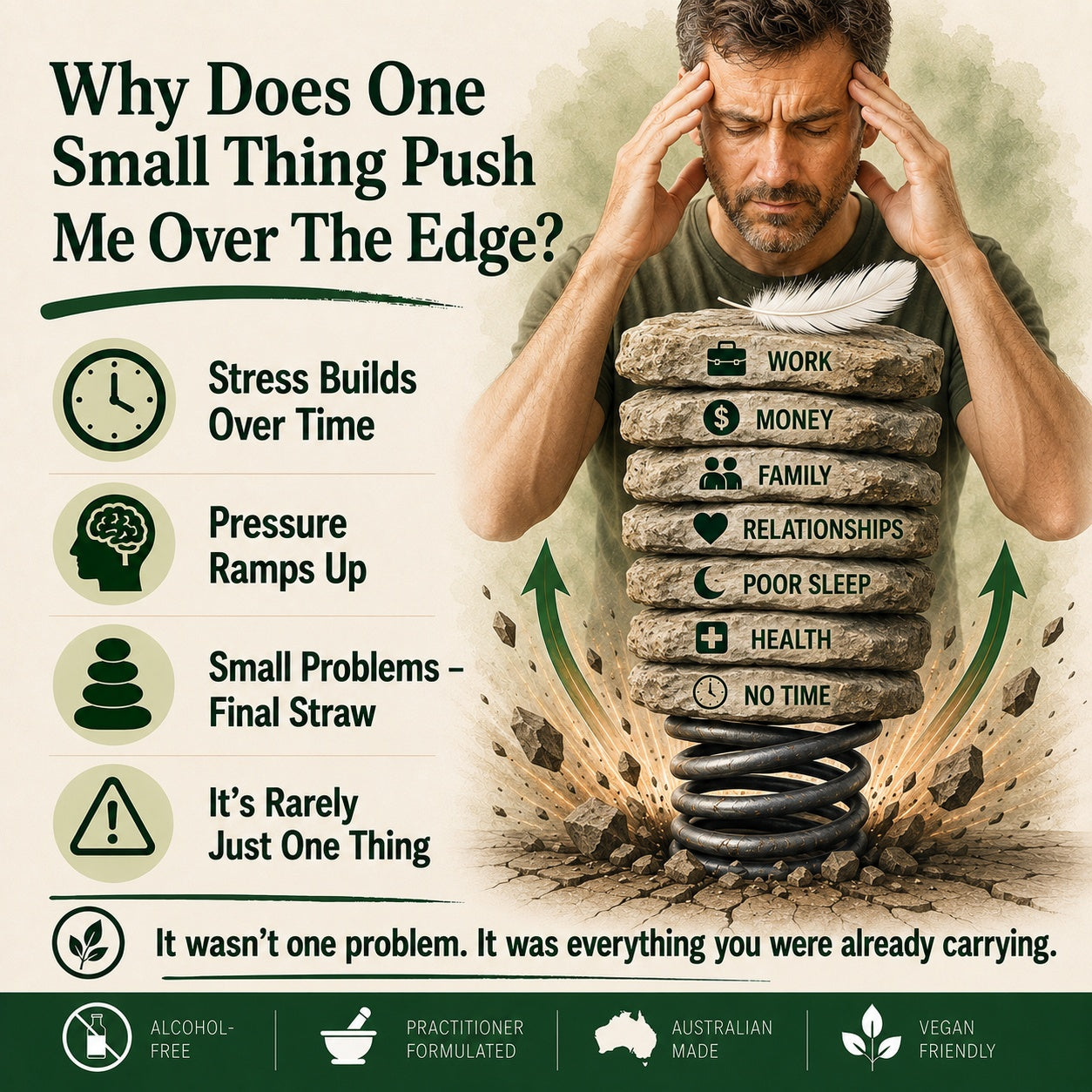
      Then someone asks you one more question, an unexpected email arrives, plans change at the last minute or something simple goes wrong. Normally, you would deal with it and move on. But when you are already stretched, that one small problem can feel like the thing that finally pushes you over the edge.

      You can easily become irritated, snap at someone or suddenly feel overwhelmed, then wonder why you reacted so strongly.

      The problem may have been small, but it landed on top of everything else you were already carrying.

      Why am I more irritable or emotional than I used to be?

      When you have been under pressure for a long time, it can take far less to trigger a reaction.

      Someone asks you a simple question while you are trying to concentrate, the children are making noise, your partner says something at the wrong moment or one more job is added to an already full day. You may snap, become unusually emotional or feel tears rising before you have even had time to think about what happened.

      Afterwards, you may feel guilty or wonder why you reacted so strongly when the situation itself was not that serious.

      It may not be the question, the noise or the comment that caused the reaction. It may be that you had no patience or emotional space left when it happened.

      Why do I feel stress in my shoulders, jaw, neck or chest?

      When you are stressed, your body automatically tightens certain muscles as though it is preparing you to deal with a threat.

      You may clench your jaw, grip your teeth, tighten the muscles around your neck and shoulders or hold your chest rigid without even realising you are doing it. Your breathing may also become faster and shallower, which can make the chest feel tight or restricted.

      If this continues for hours or happens day after day, the muscles do not get enough time to fully relax. They can begin to feel shorter, stiffer, tender or constantly knotted, even when you are sitting still or trying to rest.

      The stress may begin in your mind, but your muscles can remain physically braced long after the immediate problem has passed.

      Why does it take me so long to calm down after something stressful?

      You hang up from a difficult phone call, walk away from an argument or finally solve the problem, but your heart is still pounding, your jaw remains tight and your mind keeps going over every word that was said.

      That is because your body released a surge of adrenaline and cortisol to help you deal with what was happening. Adrenaline made your heart beat harder, sharpened your attention and tightened your muscles, while cortisol helped keep you alert and made more energy available.

      Those stress hormones do not vanish the moment the phone call ends or the argument is over. Your body has to stop releasing them and then break them down and clear them from your bloodstream. Your liver, kidneys and other tissues are involved in this process, which is why the physical rush can continue after the actual problem has passed.

      And if you keep replaying what happened, imagining what you should have said or worrying that it may happen again, your brain can continue sending the message that the threat is not completely over.

      The stressful moment may have ended, but your body is still clearing the chemical rush—and your thoughts may be keeping the alarm switched on.

      Can ongoing stress affect my concentration and memory?

      Yes. When you are stressed, your brain gives priority to whatever feels urgent—the problem you need to solve, what might go wrong next or everything you still need to do.

      That leaves less mental space for the conversation you are having, the page you are reading or where you just put your keys. You may read the same sentence three times, walk into a room and forget why you are there, or realise you have not heard the last minute of what someone was saying.

      Stress can also interfere with working memory—the short-term mental space you use to hold information while you think, make decisions or complete a task. When that space is already crowded with worry and unfinished thoughts, it becomes harder to keep track of anything else.

      You may think your memory is getting worse, but often the information was never properly taken in because your attention was somewhere else.

      Why do I feel mentally drained at the end of the day?

      You may reach the end of the day feeling completely spent, even though you have not done anything that seems physically or mentally demanding enough to explain it.

      But while you were working, driving, cooking or talking to people, another part of your mind may have been running in the background—remembering what still needs to be done, worrying about someone, replaying a conversation, planning tomorrow or waiting for the next problem to appear.

      That constant background thinking uses energy. So does holding your emotions in, staying patient when you are frustrated and trying to appear calm when you do not feel calm.

      You may feel as though you have done nothing to justify being so tired, but your mind has been working two jobs all day: dealing with what is in front of you while carrying everything else in the background.

      Is cortisol bad for me?

      No. Cortisol is not bad in itself. It is one of the hormones that helps you wake in the morning, stay alert and release extra energy when you need to deal with pressure, danger or a demanding situation.

      The problem begins when cortisol remains elevated for too long. It is meant to rise when something requires your attention and then fall again once the situation has passed. When the pressure continues day after day, the body may keep acting as though it still needs to remain prepared.

      Over time, this can make it harder to relax and sleep properly. It can also affect mood, immune function, blood glucose, appetite and the way the body stores fat, particularly around the abdomen.

      You may therefore feel tired but wired, gain weight more easily, become more irritable, catch everything going around or find that your body no longer settles as readily as it once did.

      Cortisol helps you respond to stress. The damage begins when your body keeps producing a stress response long after it should have been allowed to switch off.

      Which NatroVital products can be used alongside Cortisol Calm?

      Cortisol Calm can be combined with other NatroVital products, but the most useful combination depends on whether stress is leaving you tense and reactive, anxious and panicky, physically exhausted or struggling to recover.

      You do not necessarily need all of the products below. They may be used at different times or in different combinations depending on how stress is affecting you.

      NatroVital Adrenal Support is commonly used alongside Cortisol Calm when prolonged stress has moved beyond feeling tense or overwhelmed and is now leaving you physically drained, struggling to get going or taking much longer to recover from each day.

      NatroVital Be-Calm may be more appropriate when anxiety, panic, racing thoughts or a sudden feeling of being unable to cope are more prominent.

      NatroVital MagExcel may be used as a general foundation during periods of ongoing stress. The stress response increases the body’s use of magnesium, which can make it harder to maintain adequate levels when the pressure continues day after day.

      Magnesium is needed to help muscles relax, support normal nervous system function and assist the reactions that produce ATP—the energy used by every cell in the body. It may therefore be particularly useful when stress is accompanied by anxiety, muscular tension, restlessness, poor sleep, fatigue or feeling physically depleted.

      What makes herbal tonics different from capsules, tablets, or powders?
      NatroVital Cortisol Calm is a liquid herbal tonic made without synthetic fillers, binders, bulking agents, preservatives, flavours, or sweeteners—ingredients commonly found in capsules, tablets, and powders. Because it’s alcohol-free and doesn’t require digestion, it delivers fast-absorbing, concentrated herbal extracts in their purest form. You get only what the body needs—nothing unnecessary or artificial.

      Want to know more about what’s really in your supplements? Read our blog on excipients here.
      Why choose NatroVital over other supplement brands?

      NatroVital is a proudly Australian-owned and operated business, created by Greg Newson—a qualified naturopath, herbalist, and nutritionist with over 20 years of clinical experience. NatroVital was born out of frustration with the supplement industry. Too many products were loaded with synthetic fillers, binders, sweeteners, and unnecessary additives that offered little benefit—and often stood in the way of genuine healing.

      At NatroVital, we believe that what’s left out of a supplement is just as important as what goes in. That’s why every one of our herbal tonics is made using only pure, concentrated herbal extracts—nothing more. All of our products, including Cortisol Calm, are formulated and produced at our own facility here in Australia. We're a small, family-run business committed to clean, honest, and effective natural health solutions you can trust.

      Is Cortisol Calm suitable for vegetarians and vegans?
      Absolutely. NatroVital Cortisol Calm is 100% plant-based and free from animal-derived ingredients, making it suitable for both vegetarians and vegans.
      Are there any precautions or interactions to be aware of?
      While the herbs in Cortisol Calm are traditionally well-tolerated, please be aware of the following considerations:

      St John’s Wort: May interact with medications such as antidepressants, blood thinners, immunosuppressants, and oral contraceptives. Consult your healthcare practitioner if taking prescription medication.
      Serotonergic medications: St John’s Wort may influence serotonin levels. Use caution if taking SSRIs, SNRIs, or MAOIs.
      Anti-diabetic medications: Withania (Ashwagandha) may support blood sugar balance. Monitor if taking glucose-lowering medication.
      Thyroid medications: Withania may affect thyroid hormone levels. Use caution when combining with thyroid medication.
      Reflux: This tonic may aggravate reflux symptoms in sensitive individuals.
      Allergies: Avoid if you are allergic or sensitive to any of the listed ingredients.

      Always consult your practitioner if you’re on medication, have a health condition, or are unsure if this tonic is suitable for you.
      Is NatroVital Cortisol Calm a therapeutic medicine?
      NatroVital Cortisol Calm is made using traditional herbal knowledge and is professionally formulated by qualified health practitioners. It is not listed with the Therapeutic Goods Administration (TGA) and does not claim to diagnose, treat, cure, or prevent any medical condition.

      This tonic is designed to support the body’s natural stress response, emotional regulation, and nervous system function through traditional herbal practice. Please consult your healthcare provider if you’re unsure whether this tonic is right for your needs.

      In Australia, only products that are listed or registered with the Therapeutic Goods Administration (TGA) are permitted to make therapeutic claims. As NatroVital Cortisol Calm is not TGA-listed, we are unable to state specific health outcomes—even when supported by traditional use or research. Instead, we explain how herbs have been traditionally used in herbal medicine so you can make informed decisions about your health.
      Why isn’t NatroVital Cortisol Calm listed with the TGA?
      We’ve chosen not to list this product with the Therapeutic Goods Administration (TGA) so that we can continue to speak openly about the long-standing traditional uses of herbs. TGA listing brings strict language restrictions that often prevent us from sharing this knowledge clearly. It also requires manufacturing on a much larger scale through licensed facilities, along with substantial initial and ongoing registration costs. These factors significantly increase production expenses and limit flexibility. By creating small-batch formulas using clean, high-quality ingredients, we’re able to keep our tonics affordable and stay true to our herbal roots—without compromising quality or integrity.

      Unlike large-scale TGA-licensed manufacturers, we create our tonics using a unique process that removes alcohol after extraction and replaces it with natural vegetable glycerin. This method preserves the herbal actives while creating a clean, alcohol-free final product. It’s a more labour-intensive process that isn’t offered by conventional manufacturers, but it allows us to stay true to our values of purity, quality, and making traditional herbal support affordable and available without compromise.

      Each NatroVital tonic is created with a hands-on approach that respects the living nature of the herbs. We believe that passion, care, and healing intention are just as important as the ingredients themselves—qualities often lost in large-scale, industrial production. Our small-batch methods honour traditional herbal wisdom while delivering pure, effective tonics crafted with purpose.

    Auto-renews, skip or cancel anytime.

    Auto-renews, skip or cancel anytime.